The Rites
Freemasonry is an initiatic Order that educates by degrees and is a matter of gradual progression in self-development. The highest attainment is the grade or degree of Master Mason.
The terminology of “grades” or “degrees” derives directly from the world of the military heavily involved at the time in the prosecution of 18th century wars. There was a need for raising quality overall and maintaining the institutional stability of armies. Units of soldiers had to be fit for sustained armed conflict, and rank in the army helped keep order, provide gradual education in arms and tactics, and achieve disciplined focus.
The “Ancien régime” was the pre-revolutionary period of French history from the 15th Century forward to the revolution of 1789 and on into the Empire under Napoléon Bonaparte. The term “degree” is personally more appealing to me in its usage across the wide reach of universal Freemasonry and well outside of war. The 3 degrees are:
- Entered Apprentice
- Fellow Craft
- Master Mason
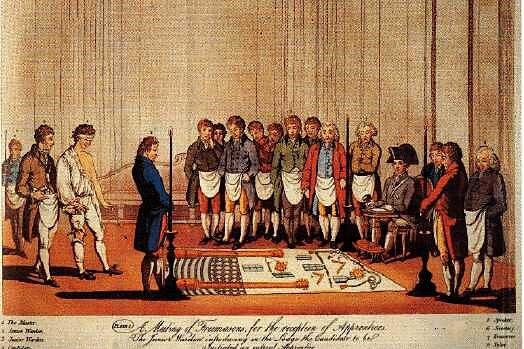 In all Rites, in all countries, these three grades exist with the same words, tokens and signs of recognition. This is what sustains the universality of Freemasonry. These three degrees are the basis of Freemasonry, and they must be practiced within the same lodge.
Nevertheless, those are not the only degrees of Masonry. Each system or Rite (a collection of rituals in a vertical hierarchical system) has added more steps in advancing by degree. For example, the Ancient and Accepted Scottish Rite has 33 degrees, but its institutions are concerned only with the degrees that go from the 4th to the 33rd. These are called the “higher degrees.” A traditional Grand Lodge, a collection of lodges that work the 3 basic degrees, does not concern itself with these elevated or advanced degrees. The entire system is a Rite, so called. Other masonic bodies such as Supreme Councils, Grand Priories, Grand Encampments, Grand Chapters, and more, are the managing institutions in these cases.
To be a member of these “higher degrees,” you have first to be a member of a blue or symbolic lodge. The blue Lodge is the foundation that practices the first 3 degrees mentioned earlier. These blue lodges combine in forming a Grand Lodge as also stipulated.
The “higher degrees” are strongly demarcated from the first 3 degrees. Thus, there are special Lodges who practice, or work, the degrees of the 4th to 14th, others of the 15th to 18th and so on. There is a strongly defined hierarchy that sustains these institutions.
The “higher degrees” can be considered as a deepening or further study and commentary of the sublime degree of Master Mason. The third degree remains the ultimate one can achieve. The English masons call the “higher degree” system Side-Masonry, or the Side Degrees: a collection of rituals with their own inherent lessons.
As an illustration, you will not see a Masonic lodge practicing or working the degrees the 1st to 18th. This Lodge would not be Masonic because it shatters the singular working of the first 3 degrees culminating with the Hiramic legend presented to the Master Mason in a ritualized and symbolic form.
The Masonic initiation from one degree to the next is not a fast moving procedure in France. A Mason will stay from 1 to 3 years as an Entered Apprentice and only then will he, or she, be proposed as someone capable of advancing to the Fellow Craft. Then, he will remain between 1 and 3 years as a Fellow of the Craft before being raised to the sublime degree of Master Mason. In other countries, such as the USA, a non-Mason can become a Master Mason within 3 months. It is a common practice. There is theoretically no set time in moving from one degree to the next, however, a sound working knowledge of the ritual, and inter-related rituals, the symbolism of the Rite and practice of Freemasonry seems to me to be a fundamental requirement for those who wish one day to become a Master Mason.
This part of the site presents the different Rites in use in the world in general, and particularly in France.